Cycling Lagos Webinar Champions Sustainable Innovation in Nigeria’s Recycling Sector
In a compelling push towards sustainable growth, environmental advocates, waste management experts, recycling practitioners, and private-sector leaders have united to emphasize the urgent need for increased investment, policy enforcement, and innovative infrastructure to transform Nigeria’s waste into valuable economic resources.
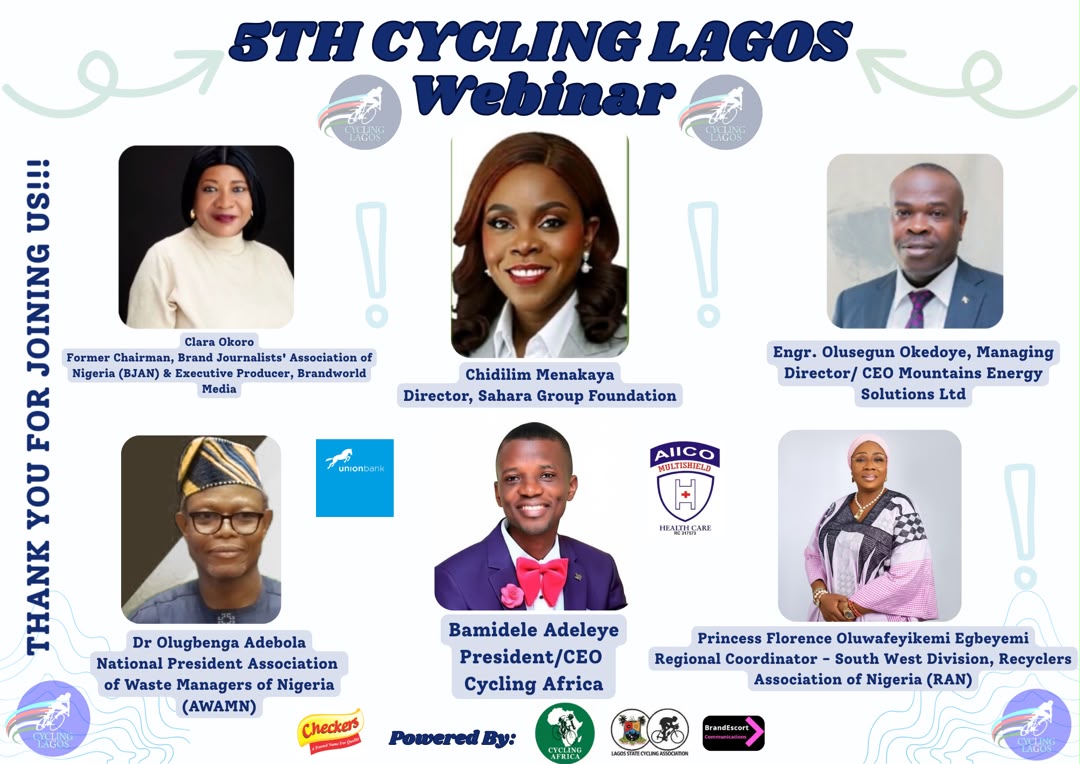
This call to action was articulated during the 5th Cycling Lagos Webinar held on Thursday, September 3, 2026. As a key prelude to the upcoming Cycling Lagos event scheduled for Saturday, September 12, 2026, at the National Stadium, Surulere, Lagos, the webinar themed “Trash to Treasure: Unlocking Recycling Capacity for a Sustainable Future,” brought together industry thought leaders to explore practical pathways for expanding Nigeria’s recycling capacity and strengthening the circular economy.
Addressing the gathering, Dr. Olugbenga Adebola, National President of the Association of Waste Managers of Nigeria (AWAMN), underscored the economic potential hidden within waste. “Waste is not waste unless you waste it. For a very long time, whether in Lagos, across Nigeria or across the continent of Africa, we have been wasting our waste,” he said.
Adebola highlighted that Nigeria’s current waste data is insufficient for effective planning, with estimates often falling short of actual waste generation. “Planning for approximately 13,000 metric tonnes of waste when actual generation exceeds 20,000 metric tonnes creates a significant deficit in collection, transportation, processing and disposal infrastructure,” he explained. Despite recycling approximately 18 percent of waste in Lagos, the volume remains low given the enormous recyclable materials entering the waste stream.
He emphasized that Lagos’s pioneering efforts in waste recovery and recycling are commendable but face major hurdles—namely infrastructure, financing, and policy implementation. “Waste management and recycling are highly capital-intensive businesses requiring affordable, long-term financing to attract and retain private investment,” Adebola stated.
Sharing personal insights, he revealed, “I have invested hundreds of millions of naira into recycling, and I am not making what I am supposed to be making. If I had gone to the bank to borrow the money, I would be in trouble today.” He called for longer-term concession agreements and stronger government-private sector collaboration to catalyze sector growth.
Adebola also highlighted the sector’s economic impact, noting that members of AWAMN contribute over 30,000 direct and indirect jobs across waste collection, transportation, vehicle maintenance, and related activities in Lagos. Workers behind collection trucks play a crucial role in recovering recyclable materials, he added, underscoring the importance of empowering the informal sector.
Investment and Behavioral Change: The Keys to Unlocking Recycling Potential
Chidilim Menakaya, Director of Sahara Group Foundation, echoed the need for increased investment in infrastructure, technology, and public education. “Most of this waste is actually wasted instead of being turned into opportunities,” she said, emphasizing the private sector’s vital role in financing and transforming Nigeria’s waste management landscape.
Menakaya highlighted Sahara Group Foundation’s “Extrapreneurship” approach, which combines economic and community empowerment aligned with the Sustainable Development Goals. She stressed that waste management is both an environmental challenge and an economic opportunity, urging entrepreneurs and youth to see waste collection as a profitable venture.
“Start small, and see how you can then scale up,” she advised, emphasizing that technology and strategic partnerships can help overcome logistical barriers. She cautioned, however, that without behavioral change—public understanding of recycling’s importance—the sector’s growth would remain stunted. “If the public do not understand the reason why they have to recycle, there is no need for you to put infrastructure in place,” Menakaya warned.
She called for stronger community education to communicate the environmental, personal, and economic benefits of recycling, while encouraging youth-led green enterprises. “A lot of people have not understood that collection is a big business and that collection is a profitable business,” she noted.
Harnessing Technology to Close the Capacity Gap
Menakaya also spotlighted the role of technology in transforming Nigeria’s recycling landscape. Sahara Group Foundation’s innovative recycling dashboard enables real-time data monitoring across various hubs, while reverse vending machines and automation tools can enhance collection and processing efficiency.
“Start small, and see how you can then scale up,” she reiterated, advocating for strategic partnerships to address logistical challenges and foster small-scale innovations that can be scaled.
Recycling as Industrial Policy: A Pathway to Economic Resilience
Princess Florence Oluwafeyikemi Egbeyemi, Regional Coordinator of the Recyclers Association of Nigeria (RAN), emphasized that Nigeria must shift from waste collection to industrial transformation. “Recycling should be treated as industrial policy, urban infrastructure, and resource security,” she said.
Egbeyemi explained that Nigeria’s abundant material streams present an opportunity to link waste recovery directly with industrial production, transforming recovered materials into market-ready feedstock. “Waste becomes material. Material becomes feedstock. Feedstock becomes product. And product creates value,” she stated.
She identified key challenges, including poor product design, contamination, and inadequate logistics, proposing an investment equation: “Predictable feedstock + predictable quality + predictable buyer = bankability.” Better implementation of Extended Producer Responsibility (EPR) was also highlighted as crucial for measurable outcomes.
Recognizing the informal sector’s vital contribution, Egbeyemi called for its formal integration through contracts, technology, and training, creating safer and more productive jobs. She proposed a regional circular economy model for the South-West, connecting Lagos, Ogun, Oyo, Osun, Ondo, and Ekiti, with potential for national replication.
Policy Enforcement and Infrastructure Development
Engr. Olusegun Okedoye, MD/CEO of Mountains Energy Solutions Ltd, pointed out that weak policy enforcement and cultural attitudes impede recycling progress. “Government has a lot of policies, there is no doubt about it, but the enforcement of those policies is nearly non-existent,” he said.
He advocated for sustainable, well-funded infrastructure development and public education to embed waste management into Nigeria’s national consciousness. “Everybody must be involved,” he urged, emphasizing the economic opportunities embedded in recycling.
A Collective Call for Action
Across the board, experts agreed that Nigeria’s recycling challenge requires collaboration among government, private investors, manufacturers, waste operators, communities, educational institutions, and consumers. Accurate data, policy enforcement, source separation, infrastructure, and market development are critical pillars to unlock the sector’s full potential.
Adebola cautioned that investment only flows when there is confidence in economic viability: “Investment will go where investors are 100 percent certain that they will achieve a viable economic return.”
Failing to bridge the recycling capacity gap would perpetuate environmental challenges, increased municipal costs, and missed economic opportunities. Nevertheless, there remains optimism that Nigeria can turn its waste into wealth with strategic stakeholder collaboration.
Cycling Lagos: Moving from Conversation to Action
In his opening remarks, Mr. Bamidele Adeleye, President/CEO of Cycling Africa Limited, emphasized that the “Trash to Treasure” theme reflects Lagos’s urgent need to address its waste crisis while unlocking economic opportunities through innovative recycling.
He reaffirmed that Cycling Lagos aims to do more than promote sport—using cycling as a platform for environmental awareness, community building, and sustainable urban development. “The waste generated today represents not only an environmental challenge but also an economic opportunity waiting to be unlocked,” Adeleye said.
As the event approaches, stakeholders are called to turn discussions into tangible actions—transforming Lagos’s waste into a catalyst for sustainable growth.
The 2026 edition of Cycling Lagos will take place at the National Stadium, Surulere, Lagos, on September 12, bringing together cyclists, environmental advocates, corporate partners, and government representatives to champion Nigeria’s journey toward environmental and economic resilience.