The PROMISE Framework: Deconstructing KOH’s 7-Pillar Brand Architecture for 2027 Campaign
By Azeez Disu
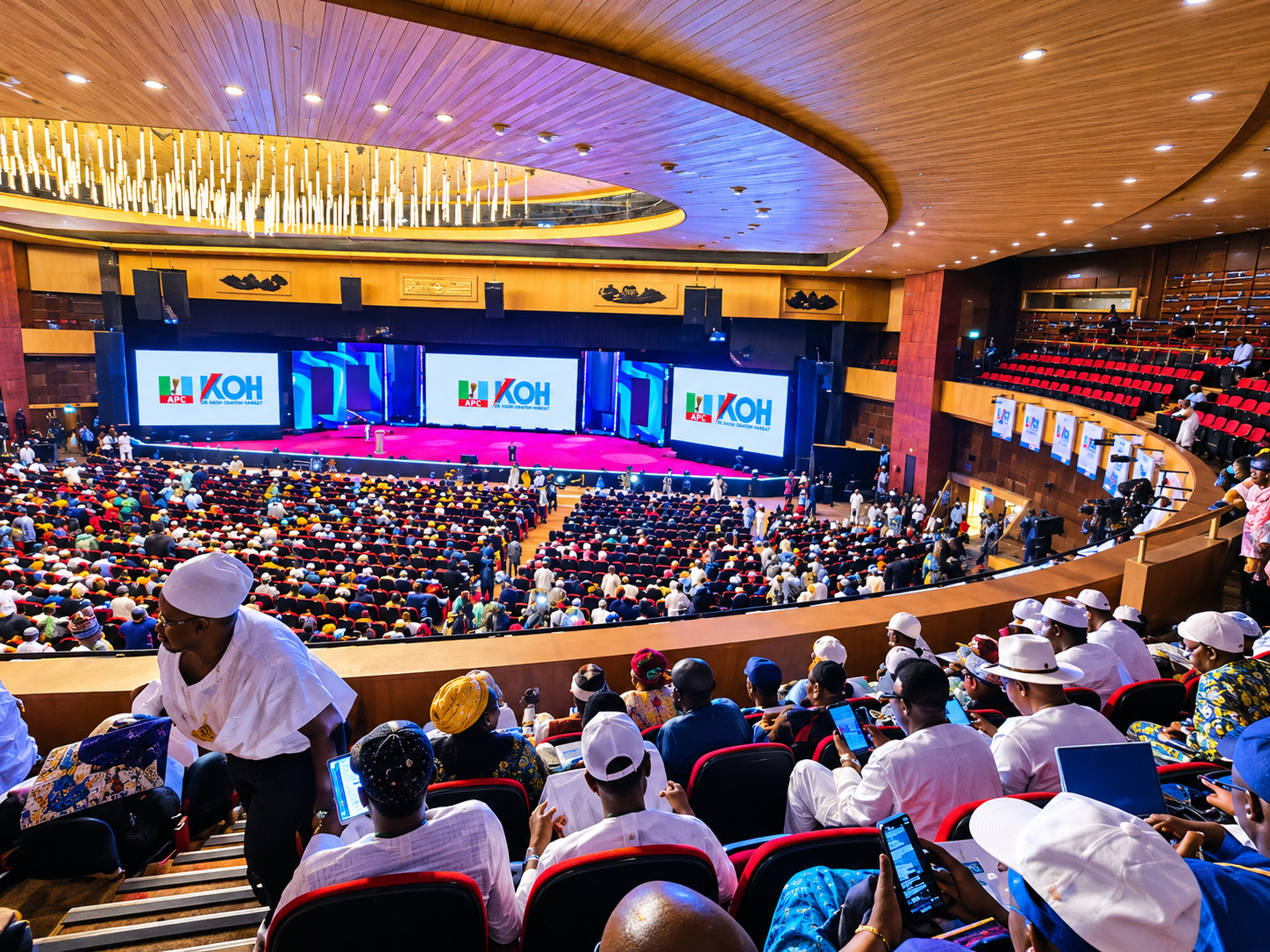
In the realm of strategic brand management, legendary marketer Philip Kotler famously asserted that “a brand is a reason to choose.” In public governance as in commercial markets, an enduring brand is far more than a corporate logo, a campaign tagline, or a crest; it represents the sum total of trust, operational consistency, and emotional resonance earned over time. On Friday, 30 October 2026, at the iconic Wole Soyinka Centre for Culture and Creative Arts (the former National Arts Theatre) in Iganmu, Lagos, this fundamental principle of brand building was brought to life in remarkable fashion.
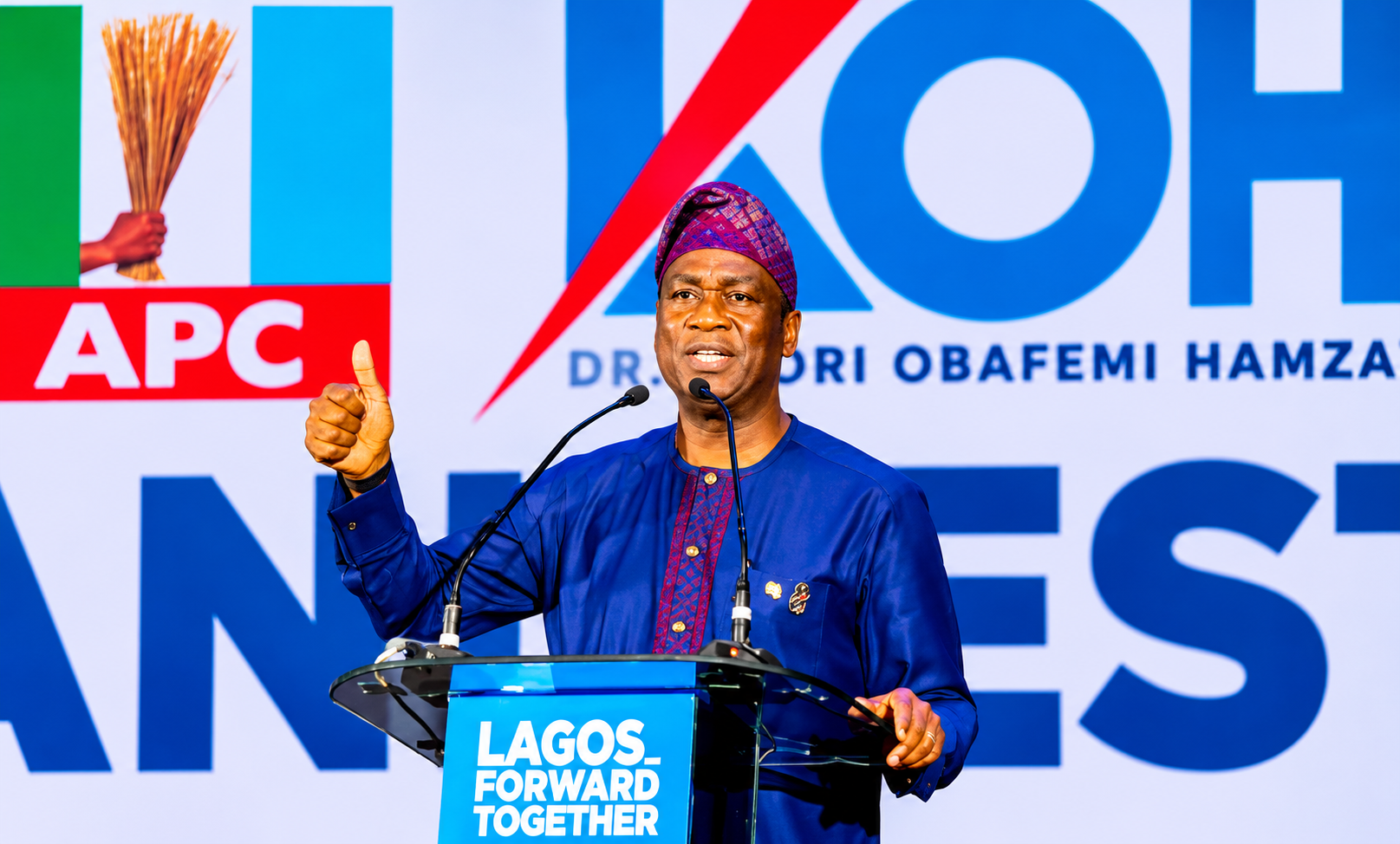
Before a distinguished assembly of party leaders, captains of industry, traditional rulers, civic groups, and thousands of citizens, the All Progressives Congress (APC) governorship candidate for the 2027 election, Dr Kadri Obafemi Hamzat (popularly known by his brand moniker KOH), alongside his running mate, Mrs Damilola Sonayon-James, formally unveiled his 2027–2031 manifesto, The Lagos Promise (Ileri Eko). Running under the campaign theme “Lagos … Forward Together”, the event was orchestrated not merely as a political launch, but as an institutional product release, a strategic blueprint in political brand architecture.
Opening the launch proceedings, the Director-General of the PBAT-KOH Campaign Council, Senator Musiliu Obanikoro, set an incisive, policy-driven tone for the brand rollout:
“Today I present not just a candidate but a clear vision for the future of Lagos State anchored on experience, continuity in development and sustained progress. This election must be about issues, ideas, competence and the capacity to deliver, not personalities or political distractions.”
Senator Obanikoro outlined the visual and digital identity of the campaign—anchored by a vibrant blue colourway symbolising stability, institutional trust, and progressive heritage, backed by a dedicated interactive web portal designed for direct voter engagement. Unpacking the core strategic proposition, he articulated the dual pillars of the campaign theme:
“‘Forward’ means sustaining progress, improving service delivery, and embracing innovation, while ‘Together’ means inclusive governance where every Lagosian, irrespective of religion, ethnicity, occupation or status, has a stake in our state.”
In brand positioning theory, Al Ries and Jack Trout emphasized that “positioning is not what you do to a product; positioning is what you do to the mind of the prospect.” By hosting the launch at the newly transformed Wole Soyinka Centre, a landmark representing cultural heritage restored to world-class standards, the KOH campaign positioned its candidate as the natural bridge between historical continuity and forward-thinking megacity transformation.
Peer Equity and Leadership Validation
A brand’s true value is validated by those who have tested its performance under extreme operational pressure. Renowned author Seth Godin defines a brand as “the set of expectations, memories, stories and relationships that, taken together, account for a consumer’s decision to choose one product or service over another.” For KOH, brand equity is backed by an extraordinary volume of peer endorsement from the highest echelon of executive leadership.
Taking the stage to present his deputy to the electorate, Babajide Olusola Sanwo-Olu, Governor of Lagos State, delivered a stirring testimony of executive synergy and operational reliability. Reflecting on their twenty-one-year professional and personal bond, Governor Sanwo-Olu stated:
“We joined this political family of the progressive the same time. We became friends, and turned brothers—some twenty-one years ago, before fate made us co-travellers on the journey of leading Lagos today. Femi, I know that you are brilliant, hardworking, dependable, caring, loyal and perform outstandingly well as Governor. For close to eight years now, we steered the ship of this state together, and on some occasions, you cruised alone when exigencies of the job took me out of the state. You acted decently, cleverly and competently.”
Governor Sanwo-Olu offered a rare insider’s perspective on KOH’s executive presence across 2,711 days of shared administration, highlighting his pivotal role during historic crises and major infrastructure milestones:
“When the first case of COVID-19 in Nigeria arrived in this city and we had to shut down the largest city in Africa, he was in the room with me. In October 2020, in the darkest week in our administration, he was in the room with me. When the Blue Line ran its first train, when the Red Line opened its doors, when the first ship was berthed, he was in the room with me, asking the questions an engineer will ask, with all the drawings on the table.”
Governor Sanwo-Olu framed this seamless administrative partnership through a vivid sports metaphor, contrasting the stability of Lagos with political friction seen elsewhere:
“Think of a relay race. In a relay, the baton is never handed to a man standing still. The next runner starts running before the baton reaches him. He runs beside the first runner inside the room, both of them at full speed, and only then is the baton placed in his hand. Lagosians have never before been offered a man who ran this long, who ran this close beside the governor he hopes to succeed.”
Political Brand Heritage: Organizational Champions & Party Continuity
In political marketing, party hierarchy and senior institutional champions function as brand custodians who reinforce authenticity and trust among the electorate. The launch of The Lagos Promise featured powerful endorsements from key party leaders who contextualized KOH’s candidature as the logical evolution of a 27-year governance legacy.
Welcoming delegates to the launch, Pastor Cornelius Ojelabi, Chairman of the Lagos State Chapter of the All Progressives Congress (APC), framed the manifesto as a formal governance contract designed to deepen societal prosperity:
“Today is more than the unveiling of a document. It is a declaration of purpose, a reaffirmation of our commitment to the people and a roadmap for the future we seek to build together. A manifesto is a covenant between a political party, its candidate and the electorate. As the governing party in Lagos State, the All Progressives Congress is proud of its achievements and determined to do more.”
Addressing the strategic necessity of political continuity, Pastor Ojelabi emphasized that sustained governance must remain dynamic:
“Lagos must move forward, not backward. Continuity must not mean unpleasantness. It must mean building on proven achievements, correcting identified shortcomings and pursuing greater progress with renewed determination. This is why we have confidence in Dr Kadri Obafemi Hamzat—his private sector experience, public service record and tenure as deputy governor have equipped him with the knowledge and competence required to navigate the complexity of governing a modern megacity.”
Echoing this perspective, Princess Sarah Adebisi Sosan, Former Deputy Governor of Lagos State and prominent member of the Governance Advisory Council (GAC), underscored the risks of unproven governance experiments in a complex metropolis:
“We are choosing right. Our candidate is intelligent, hardworking, loyal, and very committed to the Lagos project. He is the best man for the job. You cannot build a strong state by abandoning everything that has worked, nor can you start experimenting. Lagos is not for experiment; you must preserve the good, correct the areas that require improvement, and continue to make progress.”
Decoding the Brand DNA: Omoluabi Ethos Meets Engineering Discipline
Great brands are built on authentic narratives. As Apple co-founder Steve Jobs famously remarked, “Brand is simply trust.” Trust cannot be manufactured through promotional campaigns; it must be cultivated through genuine values, lived experience, and personal integrity.
Dr Kadri Obafemi Hamzat’s brand persona is rooted in the rich soil of Lagos heritage and public service. Raised in Mushin and educated at Odu Abore Memorial Primary School, KOH experienced the daily rhythms of working-class Lagosians firsthand. Recounting his early life in The Lagos Promise, KOH shared a formative moment from his youth when, at age fourteen, he encountered Chief Obafemi Awolowo outside Olivet Baptist High School in Oyo:
“He stopped close enough for me to touch him. I remember the crowd and I remember his hand raised in the victory sign. And I remember the words he left with me when I was given that rare opportunity to sit face to face with him. He said: ‘A nation rises only where people of honour and ability choose to serve.’ Those words have lingered in my mind for decades.”
This early inspiration was reinforced at home. His father, Alhaji Mufutau Olatunji Hamzat, served as a banker and later as Commissioner for Transportation under Governor Lateef Jakande in 1979, while his mother, Alhaja Kehinde Hamzat, hailed from Iga Egbe on Lagos Island. Reflecting on an unfinished rail project from his father’s era, KOH observed:
“Those who knew my father will remember the model train he kept in his living room, right up until his passing. Today, trains run in Lagos, and I have served in the government that carried that work to completion. That part of our history taught me two things: the time for the work is now, and what you finish is what you leave behind.”
KOH explicitly defines his personal brand DNA through three foundational Yoruba principles inherited from his parents—the Omoluabi Ethos:
- Iteriba (Respect): The fundamental principle that the state owes respect to every citizen it serves, not the other way around.
- Ise (Work): The unyielding commitment that real execution and tangible work must always precede public announcement.
- Otito (Truth): The governance standard holding that an administration that publishes the truth about its performance earns the enduring trust of its people.
Anchoring his executive philosophy in traditional Yoruba wisdom, KOH cited an ancient proverb: “Agba kii wa loja, ki ori omo tuntun wo“—meaning that when experienced elders are present in the market, the newborn’s head is never left unsupported or crooked. For KOH, governance is an act of elder stewardship that guarantees protection and guidance for every citizen.
Summarising his analytical approach to public administration, KOH encapsulated his brand philosophy in a concise principle: “Knowledge is a function of experience; you cannot remember what you do not know.”
Deconstructing “The Lagos Promise”: The 7-Pillar Brand Architecture
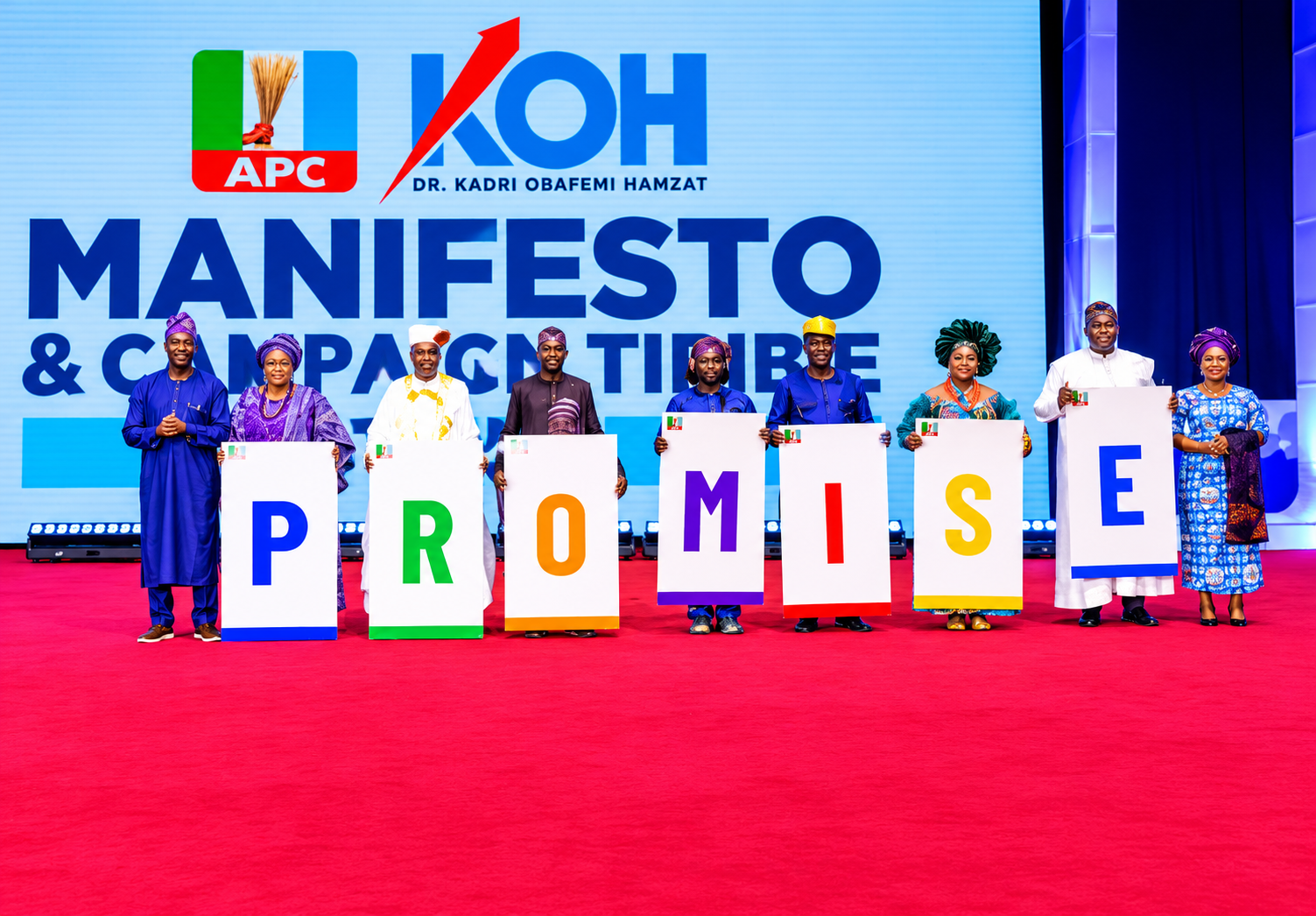
In Yoruba cultural tradition, a profound proverb asserts: “Gbese ni Ileri“—a promise is an auditable debt. KOH elevated this moral obligation into his central campaign pledge: “A promise is a load. I have lifted it onto my head before you. Gbese ni Ileri.” Anchored in sacred scriptural tenets, citing Psalm 15:4 and Surah Al-Ma’idah 5:1, KOH deconstructed The Lagos Promise (Ileri Eko) into a 7-pillar brand architecture representing 100 specific pledges.
P — People First
R — Renewal
O — Opportunity
M — Machinery of Government
I — Inclusion
S — Security & Resilience
E — Everyday Dignity
Pillar 1: P — People First (Human Capital & Social Welfare)
The People First pillar places human dignity, public health, and basic education at the center of megacity governance.
Grounded in the Yoruba affirmation A ò ní fi ẹnikẹnisílẹ (“We will not leave anyone behind”), this pillar addresses the daily vulnerabilities of Lagos households. In healthcare, KOH pledges to expand Maternal and Child Centres (MCCs) from 10 to 15 facilities, extending specialized care directly into underserved communities. The manifesto commits to scaling the Ilera Eko health insurance scheme to cover one in every three Lagosians, prioritizing indigent households to ensure that no family is bankrupted by medical emergencies. Infrastructure projects already under construction—including the 150-bed Massey Children’s Hospital, the 280-bed Ojo General Hospital, and the 150-bed Somolu General Hospital—will add 580 new hospital beds, complemented by two brand-new General Hospitals in Ogombo and Ibeju-Lekki and the comprehensive upgrading of 100 Primary Health Centres to flagship status.
In education, the brand strategy focuses on forming, retaining, and renewing human capital. Building on the foundational success of EKOEXCEL, which currently manages learning across 1,028 public primary schools and has retrained over 33,000 teachers, KOH commits to deepening digital learning tools into secondary education. To ensure that every child arrives at Primary One ready to learn, the administration will expand online and televised learning channels while reviewing teacher compensation packages to match performance expectations. Expressing his core conviction on family welfare, KOH remarked: “A mother is the first government a child will ever know. The mothers of Lagos are the makers of Lagos.”
Pillar 2: R — Renewal (Urban & Environmental Infrastructure)
The Renewal pillar addresses the physical and environmental backbone of the megacity under the motto Building Lagos to Last. Recognizing that sustainable urban growth requires heavy infrastructure discipline, KOH’s manifesto targets major interventions across transport, power, clean water, and waste management. In mass transit, the administration promises to extend the Blue Line rail to Okokomaiko and construct a major multi-modal interchange linking the Red and Blue Lines at the National Theatre Station in Iganmu. Transport planning will also advance the Green Line rail corridor running from Marina to the Lekki Free Trade Zone.
To address power deficits, the IMOLE Power Promise leverages the Lagos State Electricity Regulatory Commission (LASERC) to scale embedded generation and clean energy grids from 1,000 MW toward 3,500 MW by 2031, targeting industrial clusters in Ikorodu, Epe, and Badagry. In water provision, the administration commits to completing the massive Adiyan Phase Two waterworks, a 70-million-gallon-per-day treatment facility designed to supply clean water to six million additional residents, while rehabilitating 24 micro and mini waterworks across the state. Environmental protection will be reinforced through the Ile Mimo Clean Ground Promise, expanding waste collection coverage to 95 per cent via Private Sector Participation (PSP) operators, delivering a waste recovery and waste-to-energy plant at Agbowa, and dredging 140 kilometres of secondary drainage channels to mitigate seasonal flooding.
Pillar 3: O — Opportunity (Economic Engine & Competitiveness)
The Opportunity pillar is designed to transform Lagos into Africa’s premier commercial gateway by empowering micro, small, and medium enterprises (MSMEs) and driving digital innovation.
To boost formal enterprise, KOH pledges to scale formal MSMEs from 120,000 to 1,000,000 businesses by 2031. This economic expansion will be underpinned by the ₦10 billion LASMECO finance fund, single-digit credit windows, and a streamlined “one-stop” digital compliance hub in each of the five IBILE divisions. To create market demand, the administration will enforce a dedicated Lagos SME Procurement Quota, ring-fencing a defined percentage of state contracts for local small businesses.
To maintain global competitiveness, the manifesto sets an ambitious target to grow annual state investment from ₦1.87 trillion toward ₦5 trillion by 2031 through the Invest in Lagos platform and Deal Book. Industrialization will be anchored by four new industrial parks in Epe, Badagry, Ikorodu, and Ojo. Under the IMO Future-Ready technology agenda, the administration promises to train 1,000,000 young Lagosians in high-demand digital skills over four years, expand open-access fiber optic networks to reduce broadband costs, direct 10 per cent of government tech procurement to local startups through a First-Buyer Policy, and establish a Lagos Patent Bank to protect locally created intellectual property.
Pillar 4: M — Machinery of Government (Public Service & Institutional Reform)
The Machinery of Government pillar focuses on administrative excellence, civil service productivity, and decentralized service delivery under the social contract known as Adehun. Recognizing that citizens should not be forced to travel across the city to access basic state services, KOH commits to establishing functional Satellite Secretariats in Badagry, Ikorodu, Lagos Island, and Epe, bringing executive administration directly to the divisional level.
Public service reform will center on merit-based recruitment, digital workflow integration, and compulsory annual training (minimum 40 hours per officer). Every ministry, department, and agency (MDA) will operate under a published Service Charter that details specific service standards, named accountable officers, and explicit resolution timelines.
To institutionalize local synergy, the administration will establish the Lagos State Economic Council, bringing together the Governor, Cabinet members, and Chairmen of all 50 Local Governments and LCDAs for quarterly peer reviews and joint planning. Justice sector reforms will raise the civil jurisdiction of Magistrates’ Courts from ₦10 million to ₦50 million and expand the Office of the Public Defender and Citizens’ Mediation Bureau across all divisions.
Pillar 5: I — Inclusion (Social Equity & Universal Access)
The Inclusion pillar weaves social equity into every facet of state policy, ensuring that vulnerable, marginalized, and long-resident populations enjoy equal access to prosperity. Through the Obinrin Eko women’s agency initiative, KOH guarantees a mandatory 50 per cent women-led floor across all state enterprise funding, commercial credit windows, and vocational programs. The Domestic and Sexual Violence Agency (DSVA) and Sexual Assault Referral Centres (SARCs) will be expanded across all five divisions to guarantee absolute safety in homes, workplaces, and educational institutions.
For the youth (Omo Eko), the administration will expand the Graduate Internship Placement Programme, offering state-subsidized stipends to connect young graduates with private sector employers. Under Iyi Eko and Agba Eko, public infrastructure and public transport will be retrofitted to meet universal accessibility standards for persons with disabilities (PWDs), backed by strengthened enforcement of the Lagos State Special Peoples Law. Child protection will be institutionalized through a dedicated statutory Child Protection and Nutrition Agency, ensuring that every child under eighteen is kept in school or vocational training and shielded from abuse. Expressing his commitment to broad equity, KOH noted: “Lagos has always been a city people come to build and belong. Everyone who lives here belongs here, and Lagos will serve you as you are.”
Pillar 6: S — Security & Resilience (Public Safety & Climate Protection)
The Security & Resilience pillar outlines an intelligence-driven, community-anchored public safety architecture alongside long-term climate adaptation strategies. To guarantee peace across every neighborhood, KOH commits to expanding the Lagos State Neighborhood Safety Agency (LNSA) into every ward across all 20 LGAs and 37 LCDAs. LNSA personnel will serve as the operational foundation for future state policing frameworks. Public safety will be bolstered by extending street lighting, deploying CCTV surveillance along major commercial corridors, and establishing a State Intelligence Fusion Centre to combat cybercrime, financial fraud, and organized syndicates.
Climate resilience strategies address Lagos’s vulnerability as a low-lying coastal state. Building on the Lagos Climate Adaptation and Resilience Plan (LCARP), the administration promises continuous shoreline protection along the state’s 180-kilometre Atlantic coastline—including the expansion of the Great Wall of Lagos at Eko Atlantic. Multi-hazard disaster response will be anchored by the Lagos State Emergency Management Agency (LASEMA) operating a 24/7 coordinating spine, backed by strict structural audits by the Lagos State Building Control Agency (LASBCA) to prevent building collapses.
Pillar 7: E — Everyday Dignity (Mobility, Housing & Cost of Living)
The Everyday Dignity pillar focuses on household economic stability, urban mobility, and housing accessibility. On transport (Lagos in Motion), the administration promises an integrated, single-ticket multi-modal transit network spanning rail, road, and water. The public bus fleet will be expanded fourfold, from 1,000 to 4,000 buses, carrying over one million passengers daily. Water transport (Omi Eko) will see the dredging of 140 kilometres of navigable water channels, the deployment of 75 electric ferry vessels, and the modernization of 25 ferry terminals to make the lagoon a true “third highway.”
In housing (Home for Lagos), KOH promises to lower the barrier to home ownership by introducing a landmark mortgage benchmark requiring only 10 per cent down payment with single-digit interest rates over extended repayment terms. The state will complete ongoing housing estates—including Egan-Igando Clusters II & III, Sangotedo Phase II, Ibeshe Phases II & III, Workers’ Village Ipaja, and Ita-Marun Epe—while expanding Lagos HOMS rent-to-own schemes across Badagry, Epe, and Ikorodu. Cost-of-living interventions will focus on food security through the Lagos Food Systems Infrastructure Company (LAFSINCO), expanding cold-chain logistics hubs, and operating the 32-metric-ton-per-hour Imota Rice Mill to keep essential food items affordable for every Lagosian.
Institutionalizing Accountability: The Hamzat Compact & The Rooseveltian Standard
In public sector branding, a manifesto is only as credible as its verification mechanism. As brand strategist David Aaker observed, “Brand equity requires measurable delivery that validates customer trust over time.” To ensure that The Lagos Promise remains an auditable social contract rather than an abstract campaign document, KOH introduced The Hamzat Compact—a 6-node operational governance loop:
Promise ──► Publish ──► Review ──► Listen ──► Verify ──► Respond
The Hamzat Compact categorizes all 100 manifesto pledges with strict operational transparency:
87 Firm Commitments: Direct executive promises fully within the jurisdiction of the Lagos State Government, each tracked against published baseline indicators and quarterly scorecards.
13 Strategic Aspirations: Policy directions requiring multilateral partnerships, federal legislative concurrence, or judicial determination, where timelines are explicitly published without false deadlines.
To establish immediate delivery momentum, KOH pledged three key statutory actions within his first 100 days in office:
Child Protection & Nutrition Agency Bill: Submitting an executive bill to the Lagos State House of Assembly to establish a statutory agency guaranteeing that every child under eighteen is in school, in training, or adequately nourished.
Lagos State Service Delivery Office: Issuing an Executive Order creating a centralized delivery unit chaired directly by the Governor, mandated to publish baseline metrics for all 100 manifesto pledges.
State Wealth Fund Governance: Re-anchoring the Lagos State Wealth Fund under an independent professional board with published annual accounts to secure long-term capital reserves for future generations.
Citing American President Theodore Roosevelt’s historic 1910 address on The Man in the Arena, KOH paid tribute to the everyday workers who embody the resilience of Lagos:
“Credit belongs to the one who is actually in the arena, whose face is marred by dust and sweat. Whenever I read those words, I think of the market woman at Idumota at five in the morning, the danfo driver on Ikorodu Road, the nurse finishing a night shift in Igando, the fisherman in Epe, the coconut farmer in Badagry, the teacher in Orile-Iganmu, the artisan in Lawanson. They are the ones in the arena. Lagos is their arena. My work is to make that arena worthy of them.”
Reinforcing his commitment to transparent citizen oversight, KOH quoted a famous African proverb popularized by Chinua Achebe: “Until the lions have their own historians, the story of the hunt will always glorify the hunter.” Pointing to the pledge register in The Lagos Promise, KOH concluded:
“The Hamzat Compact makes every Lagosian a historian of my government. It puts the pen in your hand. Check it. Track it. Measure it.”
As the campaign banner unfurls across the five IBILE divisions—”Lagos … Forward Together”, the KOH brand model demonstrates how technical competence, progressive heritage, and operational accountability can unite to ensure that Èkó ò ní bàjé—Lagos will continue to flourish, lead, and endure.