The Canvas of Memory: Inside Victor Ehikhamenor’s Central Hotel
By Azeez Disu
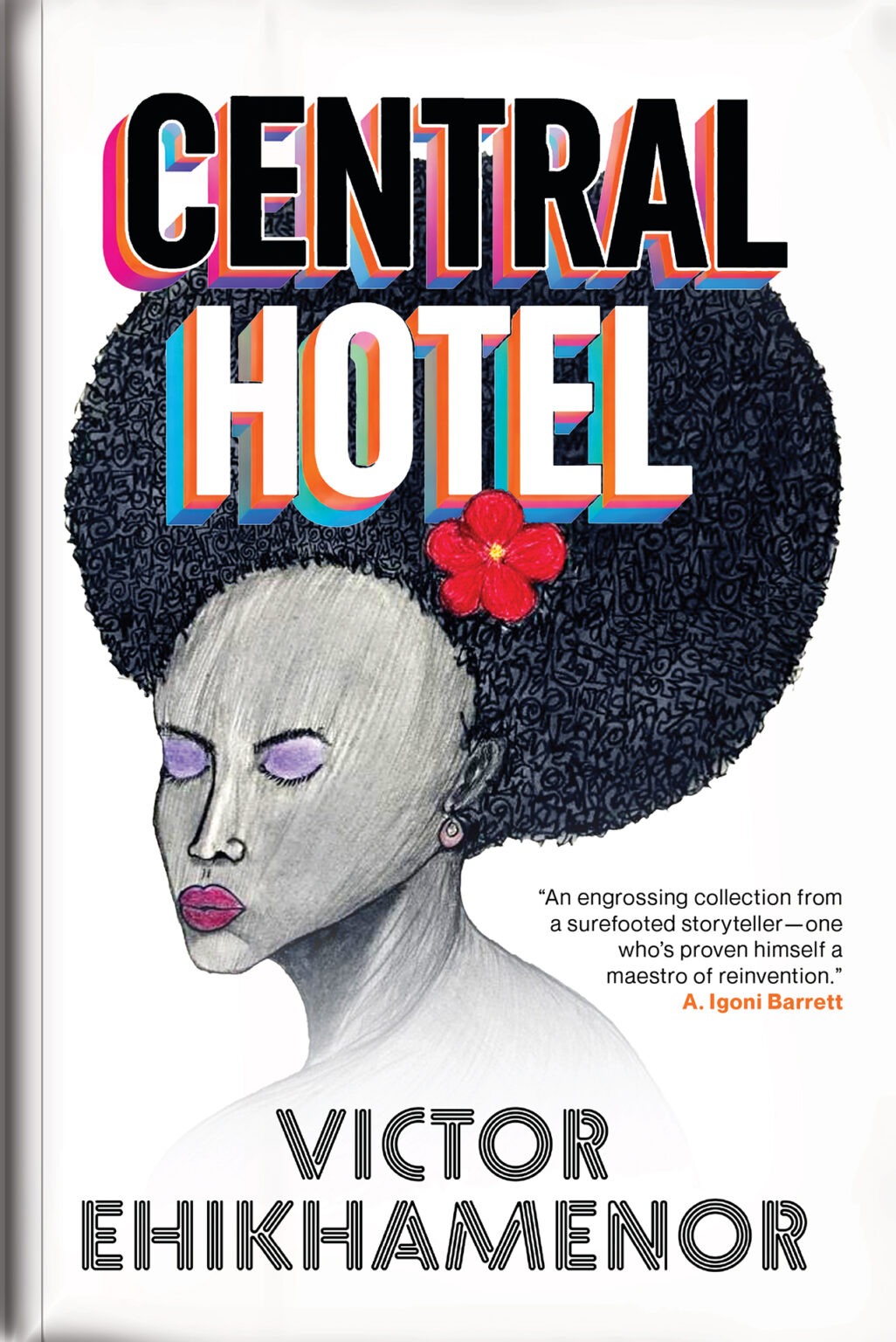
As the Nigerian proverb reminds us, “Until the lion learns to write, every story will glorify the hunter.” On 30 October 2026, in Lagos, the renowned Nigerian visual artist and writer Victor Ehikhamenor stepped forward to ensure the story remains firmly within the lion’s keeping. With the Lagos publication of his debut fiction collection, Central Hotel, published in hardback by Masobe Books ahead of its 2027 international release, Ehikhamenor presents eleven interconnected, delicately illustrated narratives spanning Nigeria and its diaspora.
Known internationally for a multidisciplinary practice spanning visual arts, cultural production, and celebrated essays in The New York Times and The Washington Post, as well as representing Nigeria at the 57th Venice Biennale, Ehikhamenor brings a painterly, sensory precision to the written word. Central Hotel is not merely a literary launch; it represents a monumental archival gathering of two decades of creative labor.
The Crucible of Memory and the Metaphysical Village
“The river that forgets its source will surely dry up.” For Ehikhamenor, narrative sovereignty is rooted in the soil of his upbringing in Udomi-Uwessan, Edo State.
“I had grandmothers who competed to tell stories every night,” Ehikhamenor recalls, reflecting on the origins of his visual and literary voice. “Those experiences shaped my understanding of storytelling and where it comes from. From them, I learnt to surrender to a story and allow it to take me where it needs to go. The form must serve the narrative, and I write in the language and rhythm in which it comes to me”.
This storytelling foundation makes the village in Ehikhamenor’s fiction far more than a rustic backdrop; it functions as an active metaphysical character. While many urbanites romanticise city lights, Ehikhamenor remains unpersuaded.
“For those that know me, they know I don’t joke with my village,” he insists.
“There’s no magic in the city; village is where the magic resides. If you can grab that and have a good memory of it, then it works. But nostalgia is a helium balloon—you go back home expecting grandeur, only to realise rooms have shrunk or life has moved on”.
This sensory grounding infuses the short story medium itself. Rejecting the notion that short fiction is merely a stepping stone to the novel, Ehikhamenor treats each story as a concentrated artistic blast.
“Short story format is quite difficult, but you have to treat it like an expression instead of a long blanket,” he explains. “It is a delicate dance of where you slow down, where you speed up, and how you tighten the frame”.
Wale Lawal on Cultural Authority and the Politics of Interpretation
A central highlight of the Lagos launch was the keynote address delivered by renowned author, scholar, and publisher of The Republic, Wale Lawal. Lawal focused his address squarely on Ehikhamenor’s artistic oeuvre, contextualising Central Hotel within the broader evolution of African intellectual history.
Lawal observed that when Chinua Achebe published Things Fall Apart in 1958, he challenged a European tradition that treated Africa merely as a backdrop for Western anxieties. However, Lawal argued that the defining battle of our contemporary era has shifted.
“We often discuss this tradition as a struggle for representation,” Lawal declared. “But I think the more profound struggle has been over interpretation—who has the authority to explain African life to determine what is valuable about it, and to decide which aspects of our own deserve to survive?”.
Lawal cautioned against mistaking international visibility for true cultural self-determination. While African artists now exhibit in global museums and top publishers, visibility can remain superficial if external institutions dictate the narrative terms.
Recalling Ehikhamenor’s 2023 London exhibition, Do This in Memory of Us, Lawal highlighted how Ehikhamenor suspended a slave ship diagram made of thousands of rosaries and lace above a mirrored floor, forcing viewers to tread over history.
“What was remarkable was how distinctly Nigerian the vocabulary of mourning was, even while addressing a transatlantic calamity,” Lawal noted. “Victor demonstrates that the particular is the true pathway to the universal. He speaks to the world without abandoning the language, memory, or cultural traditions of his community”.
Furthermore, Lawal cited Ehikhamenor’s short story In My Village, where an African archivist at the Smithsonian humorously embellishes village folklore to satisfy an American photographer’s craving for exotic danger.
“Creativity on the continent has always been a continuum,” Lawal emphasized, recalling an interview on artifact restitution. “Colonialism disrupted our societies, but it did not bring African imagination to an end. Central Hotel proves that the purpose of African storytelling cannot merely be to correct the errors of others. There must be room for stories concerned with the ordinary, the intimate, the humorous, the spiritual, and the absurd”.
Spiritual Duality and the Refusal to Translate
“The eye that sees the village does not need a telescope to view the world.” One of the most striking attributes of Central Hotel is its unruffled handling of cultural syncretism. Where Western critics often hunt for existential friction between traditional African religion and Christianity, Ehikhamenor depicts a lived reality of seamless coexistence.
Growing up with a grandfather who was a traditional priest before converting to church ministry, Ehikhamenor witnessed indigenous rituals alongside Christian prayers.
“Duality is not a strange bedfellow for an adult person,” Ehikhamenor notes with a smile. “Why use only rosaries when your grandfather used sacred chalk? Every belief system has its totem. It is like carrying two phones—there is no internal battle unless you force one”.
This confidence extends directly to his prose, where he refuses to italicise native expressions or append explanatory glossaries for Western consumption.
“We don’t have to prove that we know how to use the English language more than those who own it,” Ehikhamenor asserts. “Earlier on, I decided I was going to write for my constituency at home. When you write for the West, you end up explaining things that your own people take for granted. I write in the rhythm in which the story comes to me”.
Power, Tenderness, and The Shadow of Military Rule
“A man who does not know where rain began to beat him will not know where he dried his body.” Set predominantly between the 1980s and the early 2000s, the collection serves as a literary archive of survival under successive Nigerian military regimes.
In a moving public reading from the collection, Ehikhamenor showcased the story of Paco, a restless youth obsessed with The Godfather and military authority. Learning life lessons at a local bicycle repair shop, Paco adopts a brutal political philosophy:
“Nobody gives anybody power in this world. Power is just floating in the air; you grab as much as you can handle. Why do you think there is always a military coup?”.
This casual background of violence is balanced by poignant explorations of male friendship and vulnerability. Ehikhamenor vigorously rejects foreign definitions of masculinity that constrain African men.
“The West has robbed us by interpreting how we express friendship,” Ehikhamenor observes. “When men are not allowed to express tenderness, they end up behaving out like cooked yam—rigid, heavy, and unable to speak. In our villages, friendship is sacred. If I say I am your friend, I am your friend until you screw me badly”.
In another passage capturing urban collapse, a narrator wandering near Sweet Mama’s Bar and the dilapidated Central Hotel reflects on powerlessness amidst persistent blackouts and street crime:
“What were our bodies worth? Jobless graduate, rebellious student—what are we worth to the world when we are worthless to our own government?”.
Lessons in Publishing and The Artistic Vanguard
“The head of a king is only touched when he is being crowned or beheaded.” The journey of Central Hotel to bookstore shelves also underscores the resilience of domestic publishing infrastructure.
During the launch, the publisher of Masobe Books revealed that the manuscript had previously faced rejections from two domestic publishers who hesitated at its non-linear narrative structure.
“When I encountered this work, I was blown away,” the publisher remarked. “It is one of the best short story collections I have ever read—interconnected like a novel, rich with humor, drama, and intrigue”.
Ehikhamenor used the occasion to urge creators to support local institutions:
“We cannot complain about lacking publishing institutions and then make life difficult for those trying to build them at home,” Ehikhamenor insisted. “We must nurture the platforms that allow us to tell our stories on our own terms”.
Visually, the hardback volume mirrors Ehikhamenor’s gallery practice. Each story opens with a full-page pencil illustration featuring elongated limbs, contorted bodies, and spiralling motifs, and concludes with a detailed character portrait. The illustrations do not merely decorate; they expand the narrative text, inviting the reader into a continuous loop of visual and literary interpretation.
As Central Hotel begins its journey from Lagos to the wider world, it stands as a testament to an artist who refuses to surrender his voice. In the words of Victor Ehikhamenor himself: “We must tell our stories on our own terms, without surrendering our perspectives or allowing others to prescribe how we see and understand our world”.