AI Literacy, Trust, and CX Take Centre Stage at NIMN Ikeja 5th Annual Public Lecture
By Azeez Disu
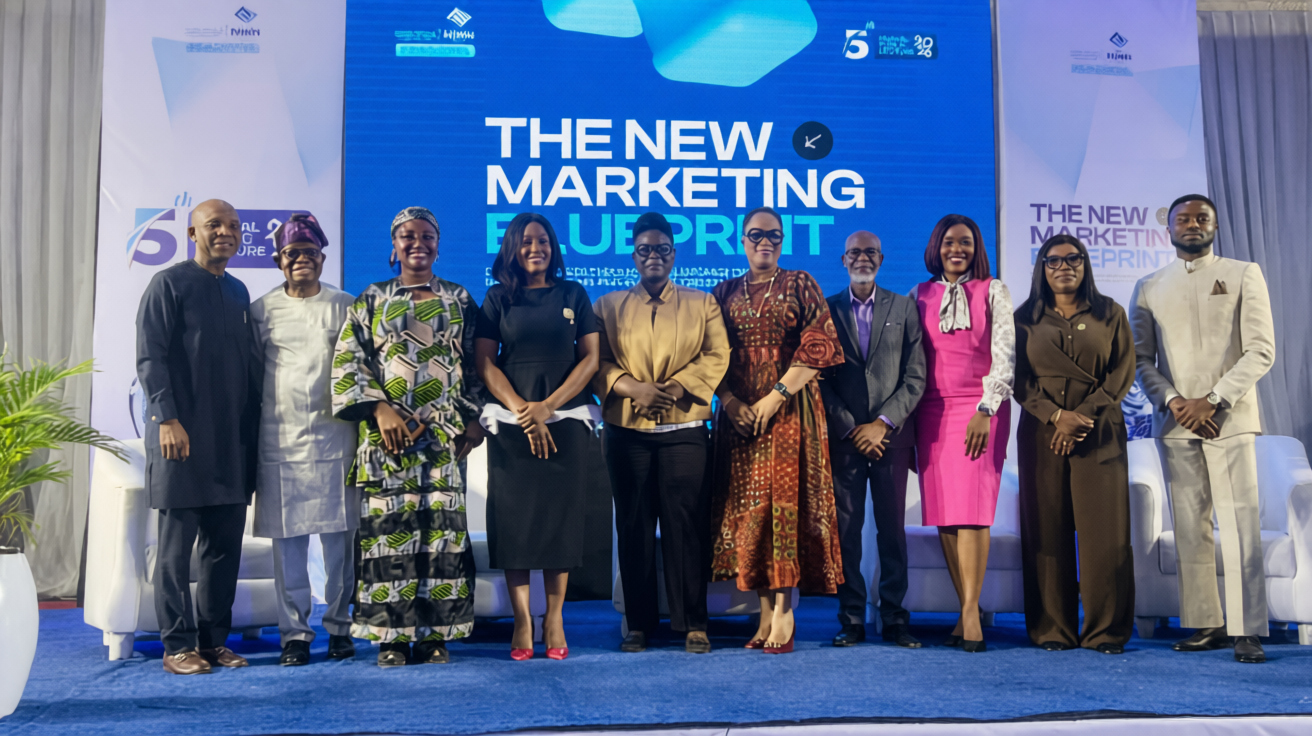
Marketing professionals, C-suite executives, academics, and industry stakeholders gathered at the LCCI Centre in Alausa, Ikeja, for the National Institute of Marketing of Nigeria (NIMN) Ikeja Chapter’s 5th Annual Public Lecture. The landmark gathering tackled the urgent need for a fundamental reset in brand strategy amidst accelerating digital disruption, shifting consumer loyalties, and economic uncertainty.
Framed around the theme “The New Marketing Blueprint: Redefining the Transformation Taking Place Across Our Profession and the Wider Business Environment,” the 2026 edition delivered a definitive roadmap for driving sustainable commercial growth through Artificial Intelligence (AI), customer experience (CX) design, connected data ecosystems, and purpose-driven brand building.
Delivering the first keynote address, Lampe Omoyele FNIMN, Managing Director and CEO of Nitro 121, declared that the marketing profession has arrived at an inflection point where traditional playbooks, once reliant on massive advertising budgets and celebrity endorsements, are no longer effective.
Citing market data showing that active mobile internet subscriptions in Nigeria have surpassed 157 million and digital financial inclusion has reached 73 per cent, Omoyele warned that despite record connectivity, brand loyalty has plummeted while customer acquisition costs have surged.
“The 2026 Nigerian consumer has changed fundamentally, they are AI-assisted, CX-aware, data-fatigued, and purpose-driven,” Omoyele stated. “For decades, we defined brand as what we tell the consumer. In 2026, brand is what the consumer experiences after we have spoken. Customer experience is no longer a cost centre; it is a growth centre.”
Omoyele presented a proprietary mathematical framework for modern growth:
\[\text{Growth} = \text{AI for Efficiency} \times \text{Customer Experience for Retention} \times \text{Data Ecosystems for Precision} \times \text{Purpose for Loyalty}\]
Addressing AI adoption, he urged Nigerian brands to move beyond mere caption generation to leveraging AI for predictive media buying, churn reduction, and rapid insight mining. “AI will not replace marketers, but marketers who are literate in AI will replace those who are not,” Omoyele emphasised. On corporate purpose, he added: “CSR is what you do with your profit. Purpose is why you exist beyond profit. Purpose is a commercial growth strategy.”
Co-keynote speaker Professor Lere Baale, Professor from Business School Netherlands International, elaborated on the strategic mechanics of the new blueprint, positioning Trust as the ultimate commercial multiplier.
“Marketing exists because customers have choices. Superior value earns attention; consistent delivery earns trust,” Prof. Baale told the audience. “Our new marketing equation is Growth = (AI × Data × CX × Purpose) × Trust. Trust will make us sustainable. Know the customer, understand them, serve them, delight them, and grow with them.”
Prof. Baale warned against mistaking raw data collection for competitive advantage, asserting that information must be processed through human judgment to achieve wisdom. He challenged corporate leaders to execute a 90-Day Transformation Challenge—spending Days 1–30 mapping customer friction, Days 31–60 redesigning priority customer experiences with AI, and Days 61–90 scaling validated pilots.
Similarly, during her Presidential Keynote Address, Dr. Bola Ajoko Bayo-Ajayi, President and Chairman of Council of the National Institute of Marketing of Nigeria (NIMN), highlighted the institute’s commitment to advancing professional standards across the country.
“Our profession is no longer defined solely by communication, advertising, or demand creation,” Dr. Bayo-Ajayi stated. “It is increasingly shaped by technology, data, changing customer expectations, and innovation. In a marketplace where consumers possess unprecedented choice and information, trust and relevance are the ultimate sources of competitive advantage. At NIMN, we remain committed to strengthening the skills, judgment, creativity, and ethical standards required for today’s marketplace.”
Omome Odili, Chairman of the NIMN Ikeja Chapter, on her part, underscored the chapter’s dedication to continuous professional development and intellectual leadership.
“Technology without strategy is simply a tool. Data without insight is simply information. And Artificial Intelligence without human intelligence creates efficiency without necessarily creating value,” Odili asserted. “The future is not AI versus marketers; the future is marketers empowered by AI. Marketing is not about making noise, marketing is about creating value, understanding people, building relationships, and driving growth.”
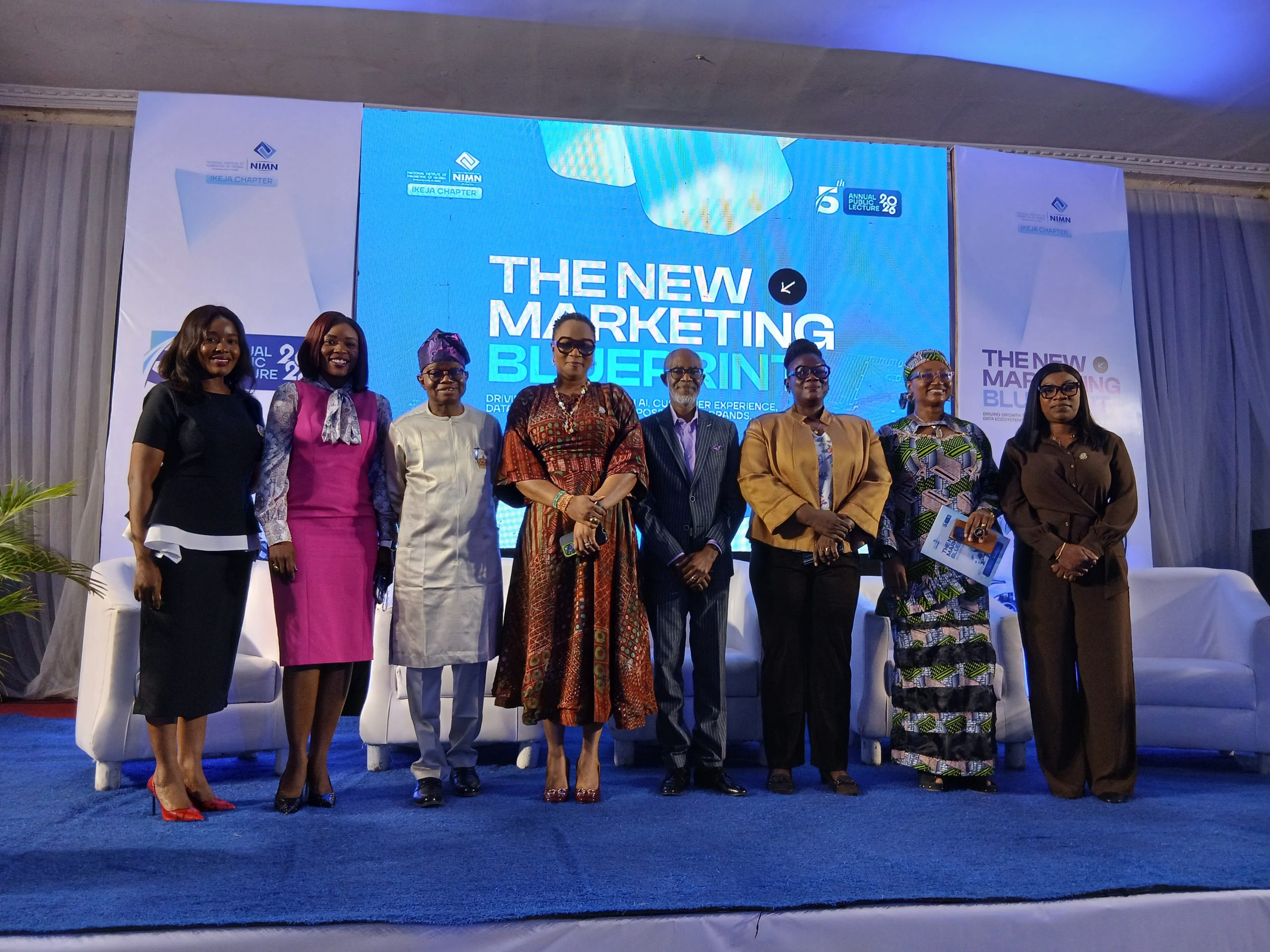
Panel Discussion: Bridging Technology, Human Intuition, and Commercial Reality
A central feature of the lecture was an interactive panel discussion moderated by Aizehi Itua, which dissected the practical application of decision science, connected data networks, and authentic brand storytelling.
Prof. Bolajoko Nkemdinim Dixon-Ogbechi, Professor of Business Administration and practicing Decision Scientist at the University of Lagos, addressed the boundary between artificial and human intelligence.
“It is only the human being that possesses the intuition, experience, and creative capability to look beyond raw numbers,” Prof. Dixon-Ogbechi argued. “AI gathers global data, but as Nigerian marketers, we must apply local, cultural, and contextual filters before implementation. When AI customer service agents reach their limits, empathic human intervention must step in to protect customer trust.”
Addressing data integration across commercial supply chains, Kehinde Ruth Onasoga, Commercial and Marketing Leader in FMCG Beverages, advocated for marketers to embrace a ‘General Manager’ mindset.
“To build a healthy data ecosystem, marketers cannot sit in an isolation booth focusing only on advertising,” Onasoga explained. “You must understand distribution, supply chains, production, and commercial margins. Furthermore, marketers must drop unnecessary industry acronyms and translate marketing data into plain commercial language that operations and finance teams can execute.”
Contributing to the discussion on digital authenticity, FMCG marketing executive and author Ms. Bodam Taiwo highlighted the necessity of personal leadership and genuine engagement in an era saturated with automated AI content.
“With AI, content is abundant, but authenticity remains scarce,” Taiwo observed. “Consumers align with brands whose leadership is visible, open, and clear about their values. As marketers, we must learn to make ‘useful noise’, storytelling that builds authentic connections and delivers tangible value.”
Omome Odili, Chairman of the NIMN Ikeja Chapter, on her part, underscored the chapter’s dedication to continuous professional development and intellectual leadership.
“Technology without strategy is simply a tool. Data without insight is simply information. And Artificial Intelligence without human intelligence creates efficiency without necessarily creating value,” Odili asserted. “The future is not AI versus marketers; the future is marketers empowered by AI. Marketing is not about making noise, marketing is about creating value, understanding people, building relationships, and driving growth.”
Panel Discussion: Bridging Technology, Human Intuition, and Commercial Reality
A central feature of the lecture was an interactive panel discussion moderated by Aizehi Itua, which dissected the practical application of decision science, connected data networks, and authentic brand storytelling.
Prof. Bolajoko Nkemdinim Dixon-Ogbechi, Professor of Business Administration and practicing Decision Scientist at the University of Lagos, addressed the boundary between artificial and human intelligence.
“It is only the human being that possesses the intuition, experience, and creative capability to look beyond raw numbers,” Prof. Dixon-Ogbechi argued. “AI gathers global data, but as Nigerian marketers, we must apply local, cultural, and contextual filters before implementation. When AI customer service agents reach their limits, empathic human intervention must step in to protect customer trust.”
Addressing data integration across commercial supply chains, Kehinde Ruth Onasoga, Commercial and Marketing Leader in FMCG Beverages, advocated for marketers to embrace a ‘General Manager’ mindset.
“To build a healthy data ecosystem, marketers cannot sit in an isolation booth focusing only on advertising,” Onasoga explained. “You must understand distribution, supply chains, production, and commercial margins. Furthermore, marketers must drop unnecessary industry acronyms and translate marketing data into plain commercial language that operations and finance teams can execute.”
Contributing to the discussion on digital authenticity, FMCG marketing executive and author Ms. Bodam Taiwo highlighted the necessity of personal leadership and genuine engagement in an era saturated with automated AI content.
“With AI, content is abundant, but authenticity remains scarce,” Taiwo observed. “Consumers align with brands whose leadership is visible, open, and clear about their values. As marketers, we must learn to make ‘useful noise’, storytelling that builds authentic connections and delivers tangible value.”