CNG, EV Investments, Jobs: FRSC Backs Tinubu’s Clean Mobility Drive, Seeks Collective Road Safety Responsibility
By Daphne Uduneje
The Federal Road Safety Corps (FRSC) has thrown its weight behind the Federal Government’s transition to Compressed Natural Gas (CNG) and electric vehicles (EVs), describing the initiative as a major catalyst for investment, job creation and Nigeria’s transition towards a cleaner and more sustainable transport economy.
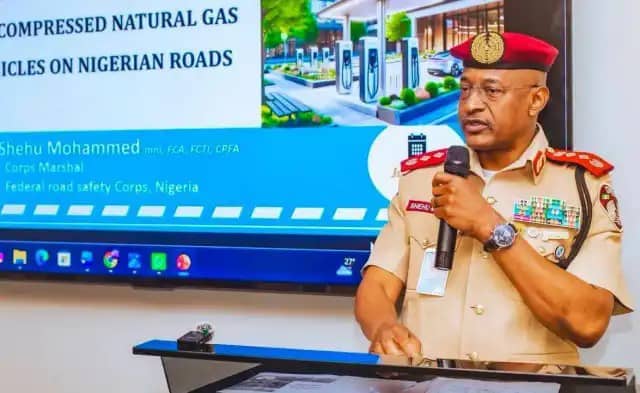
Corps Marshal of the FRSC, Shehu Mohammed, said the Presidential initiative on CNG and EVs was already stimulating investments across the automotive value chain, ranging from vehicle assembly and manufacturing to the production of CNG cylinders, conversion kits and other mobility technologies.
Speaking on the sidelines of the Nigeria Auto Journalists Association (NAJA) summit, Mohammed said the transition was not merely a transportation policy but a broader economic and environmental intervention capable of creating opportunities for young Nigerians while supporting Nigeria’s commitments to global sustainability targets.
According to him, the initiative aligns with the United Nations Sustainable Development Goals, particularly the climate action objective under SDG 13, while contributing to the broader goal of developing safer, accessible, affordable, reliable and sustainable transportation systems.
The Corps Marshal noted that the emerging clean-mobility ecosystem was already attracting significant investment into Nigeria.
“Really, it’s a massive investment that is coming into Nigeria, and also producing massive jobs for the massive unemployment that we have.”
Mohammed pointed to the emergence of vehicle assembly and manufacturing operations, as well as businesses producing CNG cylinders and conversion kits, as evidence of the expanding industrial opportunities associated with the energy transition.
Beyond the direct automotive industry, he said the shift towards alternative-fuel mobility was creating a need for technical skills and specialised expertise, potentially opening a new employment pipeline for Nigerian youths.
For the FRSC boss, therefore, the CNG and EV transition should be viewed not simply as a change in the type of vehicles Nigerians drive, but as an opportunity to build an ecosystem around cleaner mobility, manufacturing, technical services and human-capital development.
Infrastructure remains critical
Mohammed, however, stressed that the success of Nigeria’s mobility transformation would ultimately depend on infrastructure.
He expressed optimism that ongoing and proposed investments in major road corridors, including the Lagos-Calabar Coastal Highway and Sokoto-Badagry Super Highway, alongside rehabilitation of roads across the country, would strengthen the foundation for a more efficient national transportation system.
He linked these developments to the United Nations’ sustainable transport aspirations, particularly the objective of ensuring safe, accessible, affordable, reliable and sustainable transport for all.
“We are moving towards that,” he said, urging Nigerians to support policies designed to modernise the nation’s transportation infrastructure and mobility system.
The implication for the business community is significant. As Nigeria’s transportation ecosystem moves towards CNG and electric mobility, opportunities are likely to extend beyond vehicle sales to include component manufacturing, conversion services, charging and refuelling infrastructure, technical training, maintenance, energy supply and other supporting services.
Road safety: Beyond enforcement
While technology, infrastructure and cleaner vehicles remain central to the transformation of Nigeria’s transportation system, Mohammed maintained that road safety would continue to depend heavily on human behaviour.
He recalled that public education and sensitisation had been among the FRSC’s cardinal mandates since its establishment more than three decades ago. However, he acknowledged that the country still has considerable ground to cover.
According to him, road safety cannot be treated as the responsibility of the FRSC alone.
“Road safety agenda, road safety principle shouldn’t be left to the FRSC alone. It should be a collective responsibility, a holistic responsibility for all Nigerians to come on board,” he said.
He called for stronger participation by governments at the federal, state and local levels, traditional institutions, community leaders, transport operators, passengers and ordinary citizens in building a stronger road-safety culture.
The Corps Marshal argued that enforcement alone cannot address deeply entrenched practices such as speeding, overloading, dangerous driving and the transportation of passengers, goods and animals together in inappropriate vehicles.
He also drew attention to regional differences in literacy and public awareness, particularly in relation to dangerous transportation practices involving trucks and trailers.
Mohammed said the govern