EVs: Metropolitan Electric Unveils Six-Point Compact to Drive Nigeria’s Mass Adoption Agenda
By Daphne Uduneje
Nigeria’s quest to achieve mass adoption of electric vehicles (EVs) will depend less on the formulation of additional policies and more on the country’s ability to translate existing frameworks into coordinated execution, predictable investment conditions and a commercially viable electric mobility ecosystem.
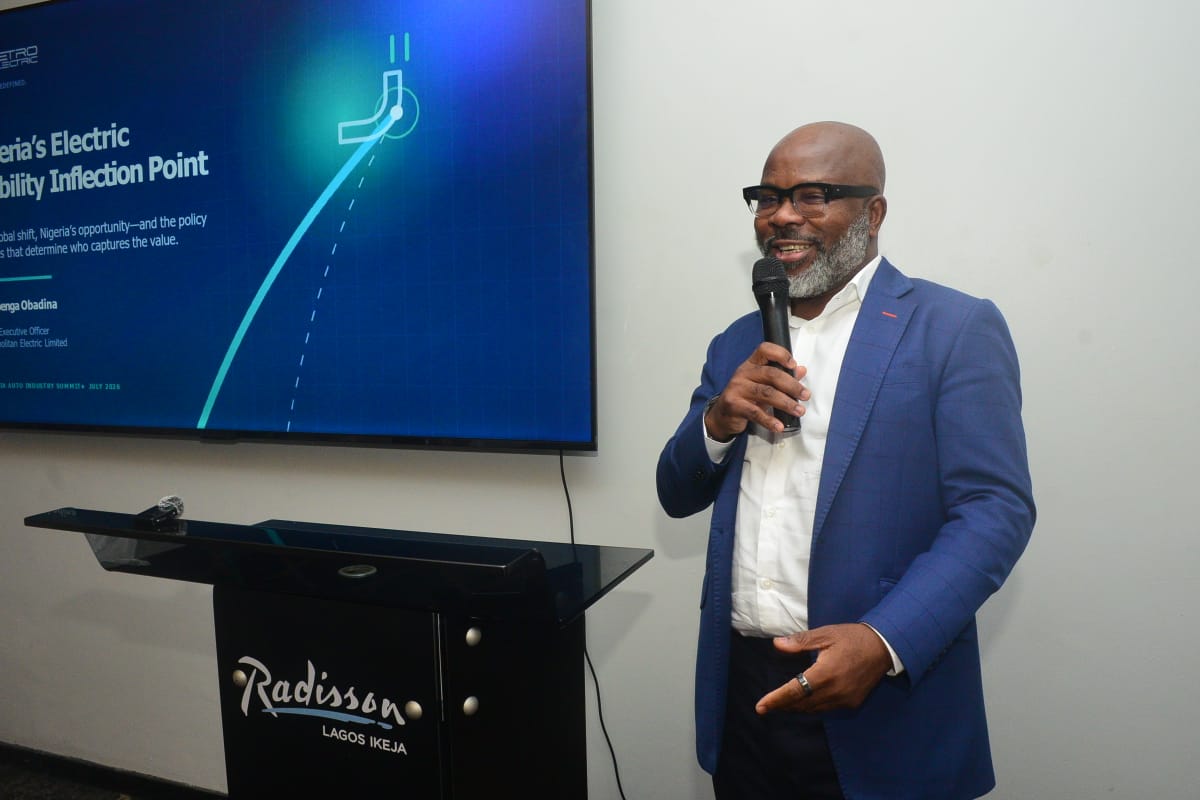
This was the thrust of a submission by the Chief Executive Officer of Metropolitan Electric Limited, Olugbenga Obadina, at the 3rd Nigeria Auto Industry Summit, organised by the Nigeria Auto Journalists Association (NAJA) in conjunction with the National Automotive Design and Development Council (NADDC) in Lagos.
Obadina said Nigeria had reached a defining point in its electric mobility transition, with several foundational policy measures already in place but significant gaps remaining in implementation, infrastructure, financing, local manufacturing and institutional coordination.
According to him, the central issue confronting Nigeria’s EV ambition is no longer whether the country has policies for electric mobility, but whether those policies can be implemented in a manner that provides investors, manufacturers, fleet operators and consumers with the certainty required to commit capital.
He cited the National Automotive Industry Development Plan (NAIDP) 2023–2033, which targets a 30 per cent local EV production share and 40 per cent local content, as one of the key policy foundations for the transition.
He also pointed to the zero-rating of Value Added Tax (VAT) on EVs and semi-knocked-down assembly parts under the Nigeria Tax Act 2025, as well as the reported reduction of EV import duty from five per cent to zero under the 2026
Fiscal Policy Measures.
Other measures, he noted, include initiatives covering EV procurement, charging infrastructure, technical standards, battery recycling and skills development.
But while these interventions represent important steps towards building an EV market, Obadina cautioned that policy accumulation without effective coordination could leave investors facing the same operational bottlenecks that currently undermine the competitiveness of the sector.
“The policy pieces are largely in place. What is needed now is to connect them, with coordination and execution across agencies,” he said.
Investment Certainty Emerges as Critical EV Imperative
For Metropolitan Electric, the next stage of Nigeria’s electric mobility journey must be anchored on policy consistency and execution certainty.
Obadina identified inconsistent tariffs, customs-related delays and demurrage costs as some of the factors capable of increasing the cost of deploying EVs and associated infrastructure while weakening investor confidence.
He argued that the private sector requires more than policy pronouncements, stressing the importance of predictable regulations, access to long-term naira financing, transparent charging permits and tariffs, and clearly defined local-content requirements.
“Investors price execution certainty, not policy intention,” Obadina said.
His position highlights a fundamental challenge facing Nigeria’s emerging EV market: the transition requires substantial upfront capital across vehicles, charging infrastructure, energy systems, technical capacity and battery management, making policy and regulatory predictability particularly important to to investment decisions.
Metropolitan Electric proposed a six-point framework it described as the “Nigeria EV Compact.”
The first pillar calls for the publication of a stable 10-year national EV roadmap, supported by a single coordinating institution with sufficient authority to align the activities of the various government agencies involved in the transition.
The second is the deliberate creation of anchor demand, through progressively higher EV procurement quotas for government fleets and public transportation.
Third is a financing model built around the concept of “financing kilometres, not cars.” The company proposed a naira-denominated green-mobility financing facility, credit guarantees and multi-year leasing arrangements to reduce the upfront financial burden associated with EV acquisition.
The fourth pillar focuses on charging infrastructure, which Metropolitan Electric wants treated as regulated infrastructure, supported by standardised permits, defined service levels and transparent tariffs to encourage private-sector investment.
The fifth recommendation is performance-based localisation, with incentives tied not merely to vehicle assembly but to demonstrable increases in domestic value addition across components, batteries, software, maintenance and other segments of the EV value chain.
The sixth is the creation of a nationwide battery circularity framework covering battery collection, diagnostics, second-life applications, recycling and responsible end-of-life management.
Together, Obadina said, the six pillars are intended to provide a more integrated framework for converting Nigeria’s growing interest in EVs into a functioning and scalable market.
Charging Infrastructure: The Missing Link
While vehicle acquisition costs remain a concern, Obadina identified charging infrastructure as one of the most decisive factors that could determine the pace of EV adoption.
Nigeria, he argued, cannot achieve meaningful penetration of electric vehicles without a charging ecosystem capable of serving private motorists, commercial fleets, public transportation and inter-city travel.
He therefore advocated a structured deployment strategy anchored on clear technical standards, transparent tariffs and predictable licensing arrangements capable of attracting private capital.
Such infrastructure, he noted, must also reflect Nigeria’s unique power environment, including the availability and reliability of electricity, appropriate energy sources and charging models that can operate sustainably within the country’s prevailing energy economics.
For commercial fleet operators in particular, charging economics will be critical.
Operators need confidence that vehicles can be charged reliably and at predictable costs before committing substantial resources to electric buses, taxis, delivery vehicles and other commercial fleets.
Financing Could Decide EV Adoption Trajectory
Beyond infrastructure, financing could ultimately determine whether EVs transition from a niche mobility option to a mainstream transportation solution in Nigeria.
Obadina placed access to affordable financing at the centre of the proposed EV Compact, noting that the relatively high upfront acquisition cost of electric vehicles remains a major barrier to widespread adoption.
Rather than depending predominantly on outright vehicle purchases, he advocated financing structures that distribute costs over the productive life of the vehicle.
The concept of “financing kilometres, not cars” is designed to promote leasing, fleet financing and other innovative structures that lower initial acquisition costs while strengthening the commercial viability of EV deployment.
For an economy where affordable, long-term financing remains a challenge across several sectors, dedicated green-mobility financing could therefore become a major determinant of the speed and scale of Nigeria’s EV transition.
Local Manufacturing Holds Key to Industrial Payoff
Localisation represents another critical component of Metropolitan Electric’s proposal.
Obadina argued that Nigeria’s EV strategy must extend beyond importing and assembling vehicles to building domestic capacity across the wider electric mobility value chain.
This, he said, should include components, battery systems, software, charging equipment, technical services and maintenance.
A deeper local industrial ecosystem would not only generate employment but could reduce foreign exchange exposure, deepen technical expertise and enable Nigeria to retain a larger share of the economic value created by the transition.
The proposition also reinforces the broader objectives of Nigeria’s automotive industrial policy, which seeks to increase local production and content while reducing dependence on imported vehicles and components.
For Nigeria, the EV transition therefore represents more than a transportation shift. Properly structured, it could become an industrial policy opportunity capable of supporting manufacturing, technology transfer, skills development and new investment.
Battery Circularity Gains Strategic Importance
Metropolitan Electric’s sixth pillar addresses a component of the EV transition that could become increasingly important as adoption accelerates: the management of battery lifecycles.
As the number of EVs on Nigerian roads increases, the country will need systems capable of handling battery diagnostics, refurbishment, second-life applications and recycling.
Obadina therefore advocated the integration of battery circularity into Nigeria’s EV framework from the beginning, rather than waiting until large-scale adoption creates significant end-of-life challenges.
Beyond environmental management, he said, a properly designed battery circularity ecosystem could create new industrial opportunities in battery servicing, recycling and material recovery.
From Policy Ambition to Market Execution
The broader message from Metropolitan Electric is that Nigeria’s EV opportunity will ultimately be determined by execution.
The country has made important progress in establishing policy and regulatory foundations for electric mobility. However, the success of those interventions will depend on how quickly they translate into predictable investment conditions, affordable financing, reliable charging infrastructure and a stronger domestic industrial base.
For Obadina, the next phase must therefore move beyond fragmented initiatives towards an integrated national framework capable of giving investors, manufacturers, fleet operators and consumers greater visibility over the direction of the market.
The proposed 10-year roadmap, coordinated institutional structure, anchor demand, green financing, regulated charging infrastructure, performance-based localisation and battery circularity framework are designed to provide that structure.
At a time when transportation costs, energy security, environmental sustainability and industrial development are becoming increasingly interconnected, Nigeria’s EV transition offers an opportunity that extends well beyond replacing petrol and diesel vehicles.
If effectively executed, the transition could stimulate new investment, technology transfer, job creation, local manufacturing and industrial diversification.
The alternative, however, is a policy environment that looks ambitious on paper but fails to create the market conditions required to support mass adoption.
For Nigeria, therefore, the challenge is no longer simply convincing motorists to embrace electric vehicles. It is about building the economic, financing, infrastructure and industrial conditions that make the transition practical, affordable and sustainable .