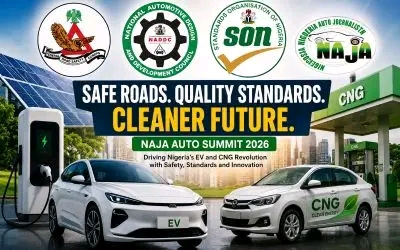
FRSC, NADDC, SON to Chart Safety, Regulatory Path for Nigeria’s EV, CNG Future at NAJA Auto Summit
By Daphne Uduneje
As Nigeria accelerates efforts to build a cleaner, more energy-efficient transport system, policymakers, regulators and industry leaders are converging to address one of the sector’s biggest challenges—creating a robust safety and regulatory framework capable of supporting the country’s transition to electric vehicles (EVs) and Compressed Natural Gas (CNG)-powered transportation.
That conversation will dominate deliberations at the 3rd Nigeria Auto Journalists Association (NAJA) Auto Summit scheduled for July 30, 2026, at the Radisson Hotel, Ikeja, Lagos, where the Federal Road Safety Corps (FRSC), the National Automotive Design and Development Council (NADDC), the Standards Organisation of Nigeria (SON) and the Federal Fire Service will unveil policy perspectives and practical strategies for advancing Nigeria’s clean mobility agenda.
Coming at a time when the Federal Government is pursuing alternative energy solutions to reduce dependence on petrol and diesel, the summit is expected to provide an important platform for aligning regulation, safety standards, industrial development and emergency response with the country’s evolving automotive landscape.
With the theme, “Nigeria’s Clean Mobility Future: The EV and CNG Journey Under the Bola Tinubu Administration,” the gathering will attract senior government officials, automotive manufacturers, energy companies, investors, transport operators, regulators and technology providers to examine both the opportunities and the implementation challenges shaping Nigeria’s clean transportation ecosystem.
A major highlight of the summit will be the presentation by the Corps Marshal of the Federal Road Safety Corps, Shehu Mohammed, who is expected to unveil a comprehensive safety framework for the deployment of electric and CNG-powered vehicles across the country.
His address will focus on vehicle certification, roadworthiness standards, accident prevention, emergency response procedures, technician training and public awareness initiatives, issues regarded as fundamental to ensuring that Nigeria’s transition to cleaner transportation does not compromise road safety.
Industry observers believe the FRSC’s position is particularly significant as the increasing adoption of alternative-fuel vehicles demands new regulatory approaches, specialised technical expertise and stronger collaboration among safety agencies, manufacturers and transport operators.
Also expected to provide strategic direction is the Director-General of the National Automotive Design and Development Council (NADDC), Joseph Osanipin, whose keynote presentation will examine how Nigeria’s automotive industry can leverage the Federal Government’s clean mobility policy to stimulate industrial growth, deepen local vehicle manufacturing and attract fresh investment into the sector.
His presentation is expected to highlight the opportunities emerging from Nigeria’s automotive transformation agenda and the role of local manufacturing in positioning the country as a regional hub for cleaner mobility technologies.
On the regulatory front, the Director-General of the Standards Organisation of Nigeria (SON), Dr. Ifeanyi Chukwunonso Okeke, will outline the standards required to guarantee the safety, quality and reliability of electric vehicles, batteries, charging infrastructure, CNG conversion kits, cylinders and refuelling stations.
His address is also expected to focus on eliminating substandard products from the market while strengthening consumer confidence through effective standards enforcement and quality assurance.
Complementing the regulatory and safety conversations, the Controller-General of the Federal Fire Service, Olumode Samuel Adeyemi, will examine emergency preparedness within Nigeria’s emerging clean-energy transport ecosystem.
His presentation will explore national response protocols for EV and CNG-related incidents, while highlighting the need to equip firefighters and others.