NCISPE 2026: “Nigeria Represents Africa’s Most Compelling Investment Opportunity in Ceramics,” says Prof. Oaikhinan
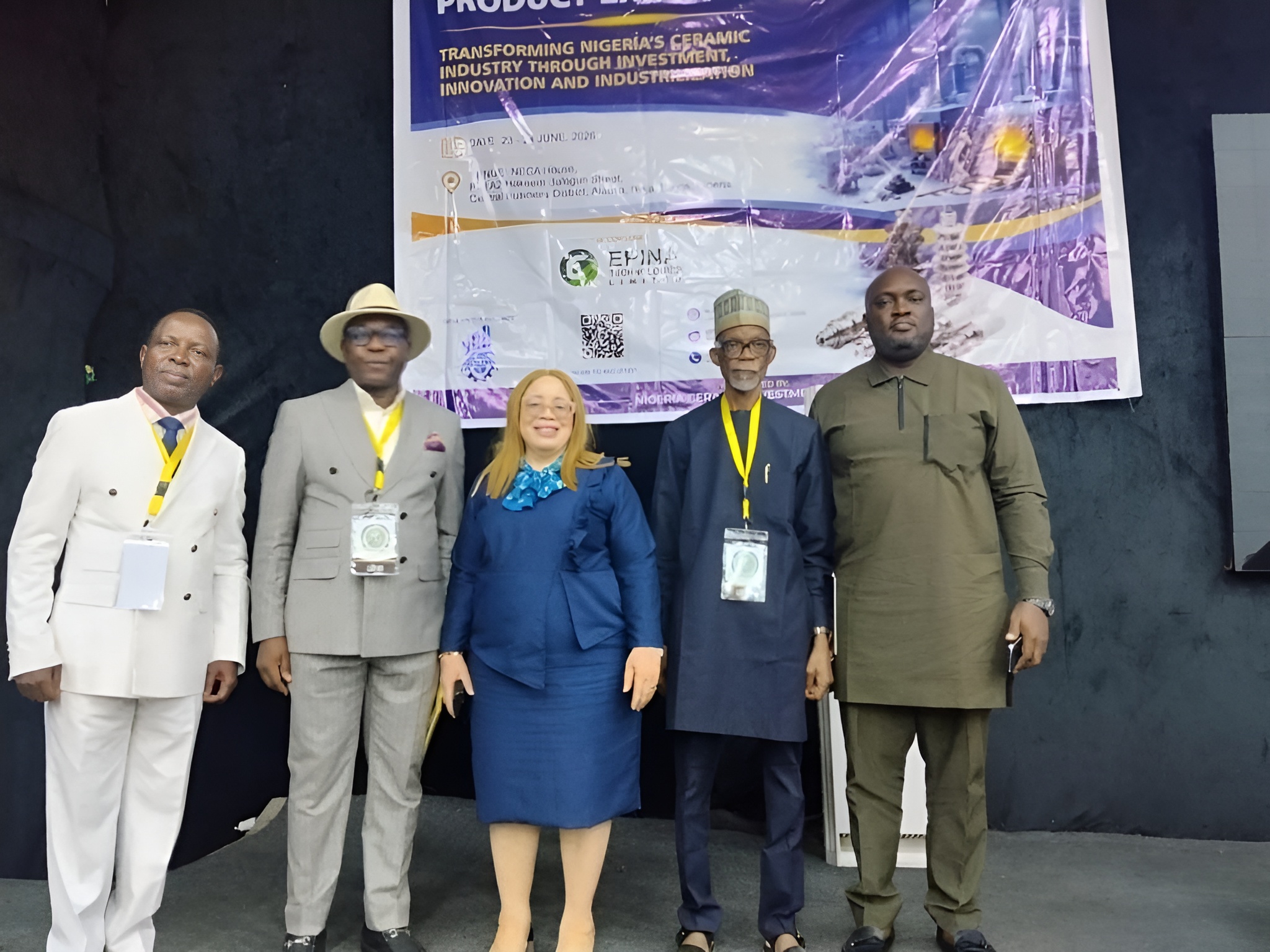
By Azeez Disu
The maiden Nigeria Ceramic Investment Summit and Production Exhibition (NCISPE) opened with a call to action at NECA House, Lagos, as industry experts and investors gathered to explore the untapped potential of the nation’s solid minerals. Delivering the keynote presentation, Engr. Prof. Eguakhide Patrick Oaikhinan, Professor of Ceramic Engineering and CEO of Epina Technologies Limited, declared that “Nigeria’s ceramic industry represents one of Africa’s most compelling industrial investment opportunities”.
Prof. Oaikhinan’s presentation, titled “Nigeria’s Ceramic Industry – A Gateway to Growth and Investment,” painted a vivid picture of a sector ready to transition from heavy import dependence to a regional manufacturing powerhouse. He noted that while the global ceramic industry is currently valued between $250 billion and $360 billion, and is projected to exceed $435 billion by 2033. Africa remains significantly underrepresented despite its vast resources.
A Strategic Advantage Rooted in the Earth
Addressing a hall of stakeholders, Prof. Oaikhinan highlighted Nigeria’s “Natural Resource Advantage,” noting the country possesses substantial deposits of Kaolin, Feldspar, Quartz, Silica Sand, Ball Clay, Talc, and Bentonite.
“Most ceramic minerals occur in commercially viable quantities suitable for industrial development,” he observed, specifically pointing to over 2 billion metric tons of high-grade kaolin spread across the North-West, North-Central, South-West, and South-East zones. He further detailed the geographical spread of other vital materials, such as the major feldspar deposits in Kogi, Ogun, and Ekiti states, and the extensive silica reserves found in the coastal regions of Lagos, Delta, and Ondo.
Market Drivers and the Housing Deficit
The Professor argued that the investment proposition is bolstered by a “Market Advantage” that includes a population exceeding 230 million and a rapidly growing middle class. He identified the nation’s massive housing deficit, estimated in the millions of units, as a primary driver for Building Ceramics, including floor, wall, and roofing tiles.
“Nigeria faces a housing deficit estimated in the millions of units, creating sustained demand for ceramic products,” Oaikhinan stated, adding that urban expansion and infrastructure projects like hospitals, schools, and airports are further accelerating the need for local production.
The Path to Import Substitution and Economic Growth
A central theme of the presentation was the strategic goal to “produce locally what Nigeria currently imports”. Currently, items ranging from tableware and sanitary wares to electrical insulators and technical ceramic components are largely brought in from abroad.
Prof. Oaikhinan detailed the “Economic Benefits of Local Production,” which include foreign exchange savings, local job creation, technology transfer, and an improved trade balance. He envisions Nigeria as more than just a consumer, but as “West Africa’s leading ceramic manufacturing and export hub,” leveraging the African Continental Free Trade Area (AfCFTA) to access a market of 1.4 billion consumers.
Overcoming Challenges through Sustainability
While acknowledging “Current Industry Constraints” such as high energy costs, infrastructure gaps, and limited access to finance, the Professor offered a roadmap for success. He called for a shift towards “Sustainability and Green Industrialisation,” recommending the use of energy-efficient kilns, renewable energy integration, and waste recycling to lower production costs and ensure environmental compliance.
He emphasized that for the industry to thrive, “Investment Enablers” must be in place, including government support, tax incentives, and international partnerships with nations such as Italy, China, India, and Türkiye for technology transfer and joint ventures.
A Vision for the Future
Beyond traditional tiles and toilets, Prof. Oaikhinan shared a “Long-Term Vision” that includes Advanced Ceramics for medical devices, aerospace components, electronics, and semiconductor technology.
“Our vision is a globally competitive ceramic industry that drives sustainable industrialisation and improves quality of life,” he concluded, stressing that the sector’s growth would lead to significant social contributions, including youth employment and women entrepreneurship.
His conclusion is that, with the right alignment of resource availability, industrial policy, and private sector leadership, Nigeria’s ceramic industry is no longer just a possibility; it is an inevitability.