Rabiu and Elumelu Align on Nigeria’s Industrial Future as BUA Foods Posts N1.77 Trillion Revenue
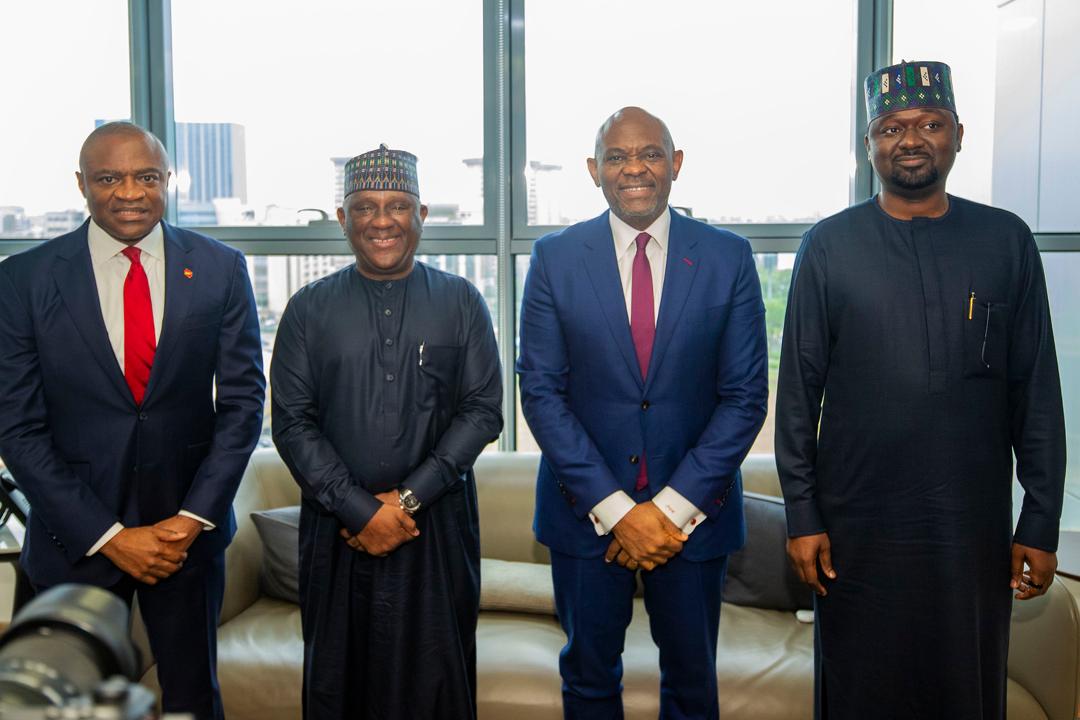
Nigeria’s leading industrial and financial giants are deepening a longstanding partnership that has quietly fueled decades of growth. The Founder and Chairman of BUA Group, Abdul Samad Rabiu, hosted Tony Elumelu, Chairman of United Bank for Africa (UBA), along with UBA’s executive management team at BUA Group’s corporate headquarters in Lagos.
This gathering was more than a routine visit; it brought together two institutions whose alignment of capital and industrial capacity has consistently translated into scale, execution, and long-term value creation across Nigeria and Africa’s economy.
Central to their discussions was a renewed effort to expand financing frameworks for large-scale manufacturing, bolster support for domestic production, and unlock new growth opportunities across food, infrastructure, and export-oriented value chains.
Rabiu, reflecting on nearly three decades of collaboration, traced its evolution from the early days of Standard Trust Bank to its current form as a trusted, mature partnership with UBA.
“Enduring partnerships are not built on transactions, but on conviction,” Rabiu stated. “What we have built with UBA and the Nigerian financial industry over the years is a shared understanding of where Nigeria is going and what it will take to get there. That alignment remains as strong today as it was at the beginning.”
Elumelu emphasized the strategic importance of this relationship, situating it within a broader vision of African-led growth.
“Institutions like BUA Group demonstrate what is possible when long-term capital meets disciplined execution,” Elumelu said. “Our role is to continue enabling that scale, supporting enterprises that are not only growing but reshaping the Nigerian economy.”
The meeting underscores a broader convergence of capital and industry at a time when Nigeria’s growth is increasingly driven by indigenous scale, operational depth, supportive government policies, and sustained investment in core sectors.
In a parallel demonstration of this scale, BUA Foods, a subsidiary of BUA Group, announced its audited financial results for the year ending December 31, 2025, reporting revenue of N1.77 trillion—up 16 percent from N1.53 trillion in 2024.
The strong performance reflects sustained demand across key segments such as sugar, flour, pasta, and rice, alongside ongoing execution of its expansion strategy.
Gross profit rose to N737.26 billion from N540.82 billion, while profit after tax surged by 95 percent to N518.4 billion, compared to N265.99 billion in the previous year.
Earnings per share increased to N28.80, reinforcing the company’s robust earnings profile.
In line with its commitment to shareholder value, the Board proposed a dividend of N28 per share—an increase of 115 percent from N13 in 2024—with a total payout of N504 billion, subject to shareholder approval.
Cost of sales stood at N1.037 trillion, and total assets grew by 27 percent to N1.39 trillion, reflecting ongoing investment across operations and the broader value chain.
Speaking on the results, Abdul Samad Rabiu, Chairman of BUA Foods, said, “Our 2025 performance reflects a business that is not only growing, but scaling with discipline. We are building capacity, deepening local production, and delivering consistent value to shareholders, all while positioning for the future.”
The Managing Director, Engr. Ayodele Abioye, added, “Our strategy remains to expand capacity, strengthen market presence, and optimise the full supply chain. The demand signals are strong, and we are well positioned to sustain this momentum.”
Together, the high-level meeting between BUA Group and UBA and BUA Foods’ record-breaking performance highlight a broader shift in Nigeria’s economic landscape. The country’s growth is increasingly driven by institutions that combine scale, capital discipline, and long-term vision—signaling not just expansion but a consolidation of industrial leadership.